
Leonard Richmond (1889-1965)
Biography
Leonard Richmond was an English painter, teacher, writer, and designer whose career spanned both sides of the Atlantic and whose work became closely associated with the evolution of 20th-century British and Canadian landscape painting. Born in Somerset in 1889, Richmond first trained at Taunton School of Art before continuing his studies at Chelsea Polytechnic in London, where he refined the disciplined drawing and painterly techniques that would later make him a sought-after exhibitor, illustrator, and educator.
Early Career and War Service
By the early 1910s Richmond was living in Brentford (1912) and then Southall (1914), building his practice while contributing to the lively artistic community in and around London. The First World War marked a major turning point in his career. During the conflict he served as a war artist for the Canadian Government, working alongside two other prominent British painters, Augustus John and Alfred Munnings. This prestigious appointment forged Richmond’s long-standing links with Canada and introduced him to the vast, dramatic landscapes that would later inspire some of his finest commercial and poster work. Nineteen of his war paintings were included in the important Canadian War Memorials Fund Art Exhibition at the Royal Academy London in 1919 (also shown in New York, Toronto and Montreal) a landmark display that significantly raised his public profile and helped establish his reputation beyond the artistic community. One of these paintings depicting the construction of a railway built in the deepest trench in France by the Canadian Overseas Railway Construction Corps is hung in the Canadian Senate, Ottawa.
In April 1921 the influential art publication The International Studio ran an editorial on Richmond, penned by the novelist and critic Wilfrid Hugh Chesson. Chesson stated that Richmond was, ‘one of the most original and poetic contemporary landscape painters, an exquisite colourist who so loves trees that he sees them as no eye obsessed by outwardness will ever see them.’
Work in Canada and the Rise of His Poster Art
During the mid-1920s, following the war, Richmond returned to Canada to lecture, paint, and undertake commissions. In 1925 he was engaged by the Canadian Pacific Railway to produce a series of large, colourful promotional posters advertising western Canada, its hotels, and the spectacular scenery of the Canadian Rockies. These posters – bold, modern, and brilliantly coloured – were widely admired and became some of the most iconic travel advertisements of their era. His expertise in this field soon led to further commissions from English railway companies, including the Southern Railway and the Great Western Railway. His poster Cornwall, for example, captured the luminous Cornish light and became emblematic of the region’s allure to holidaymakers.
St Ives, Cornwall, and the West Country
The 1930s saw Richmond develop a deep affinity with West Cornwall, particularly St Ives, then one of the most dynamic plein-air art colonies in Britain. Drawn by the town’s legendary clarity of light and its vibrant artistic community – already celebrated by figures such as Laura Knight and Alfred Munnings – he became a regular visitor. Richmond took a studio in St Ives in 1932 and, recognising the area’s appeal to aspiring painters, founded a summer painting school there in 1935.
Richmond’s engagement with Cornwall followed a pattern familiar among British artists of the early 20th century: an early period of work in the region, a return to London or abroad, and later a renewed attachment to West Cornwall. For Richmond, this later period came after the Second World War, when he returned to the county from 1946 to 1949. Several pastels in circulation today come from the group acquired by fellow artist Hyman Segal when he took over Richmond’s St Ives studio.
Exhibitions, Awards, and Professional Recognition
Richmond exhibited widely and prolifically throughout his career. His works appeared at the Royal Academy, the Fine Art Society, Cooling Galleries, Walker’s Galleries, and numerous other London venues. Internationally he showed across Europe and North America, gaining significant recognition. His awards included the Tuthill Prize at the Chicago International Watercolour Exhibition in 1928, and a silver medal at the Paris Salon in 1947 – achievements that placed him among the leading landscape painters of his day.
He was an elected member of several major professional societies including the Pastel Society, the Royal Society of British Artists (RBA), the Royal Institute of Painters in Water Colours (RI), and the Royal Institute of Oil Painters (ROI).
Teaching and Writing
Richmond was also a respected teacher and author. Alongside studio teaching and his St Ives summer school, he wrote several influential instructional books, including The Art of Landscape Painting (Sir Isaac Pitman & Sons Ltd, 1927), The Technique of Water-colour Painting (Sir Isaac Pitman & Sons Ltd, 1927), The Technique of Oil Painting (Sir Isaac Pitman & Sons Ltd, 1931), The Technique of the Poster (Sir Isaac Pitman & Sons Ltd, 1933), and Essentials of Pictorial Design (Sir Isaac Pitman & Sons Ltd, 1933) all widely used by students and amateur painters during the mid-20th century. His literary work extended into travel writing and illustration, most notably Devon and Cornish Days for the Southern Railway and The Enchantment of Canada for the Canadian Pacific Railway – publications that blended his love of landscape with his interests in design and tourism.
Legacy
Leonard Richmond’s legacy lies in his versatility and geographical reach: a painter of British and Canadian landscapes, a war artist, a designer of celebrated travel posters, a committed teacher, and an author whose books shaped generations of aspiring artists. His work forms part of the broader story of plein-air painting in the West Country – an art movement that revolutionised British landscape painting in the late 19th and early 20th centuries and helped transform towns like St Ives into international artistic centres.
Richmond died in 1965, leaving behind a rich and varied body of work that continues to attract collectors, historians, and admirers of early-20th-century British and Canadian art.
Showing all 2 results
-
SOLD
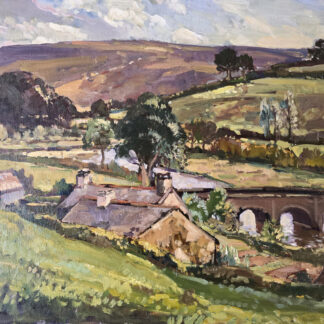
Leonard Richmond (1889-1965) – The River Barle, Withypool, Exmoor
Read more -
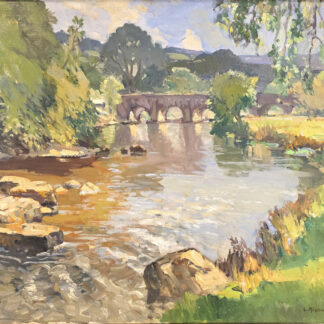
Leonard Richmond (1889-1965) – Withypool Bridge, Exmoor
£4,250.00 Add to cart
Showing all 2 results